Case Study: The Fastest Way to Deploy an Ultra-Fast SEO Website Using Agentic AI
If you hang around SEO groups long enough, you’ll inevitably see a variation of this question pop up: “What platform are you using to build lightweight, ultra-fast SEO websites with AI? Astro, Next.js, WordPress, Webflow?”
The consensus seem to be that if you want super fast deployment speed, breakneck PageSpeed performance, and a lightweight DOM, you had to abandon WordPress for headless frameworks like Astro or Next.js. If you stayed with WordPress, you accepted a certain level of bloat.
I never subscribed to this paradigm.
With the rise of Agentic AI and the Model Context Protocol (MCP), the bottleneck is no longer just the platform; it is the workflow. I recently deployed a lightning-fast, highly optimized SEO website entirely orchestrated by AI agents. And, it is on our good ol’ friend WordPress.
This case study breaks down the exact cutting-edge stack I used to design, iterate, deploy, and manage a WordPress site without manually touching a server configuration or writing a line of boilerplate code.
The Cutting-Edge AI & WP Stack
To build a site that satisfies modern Core Web Vitals while retaining the familiar CMS benefits of WordPress, I utilized a fully AI-driven pipeline.
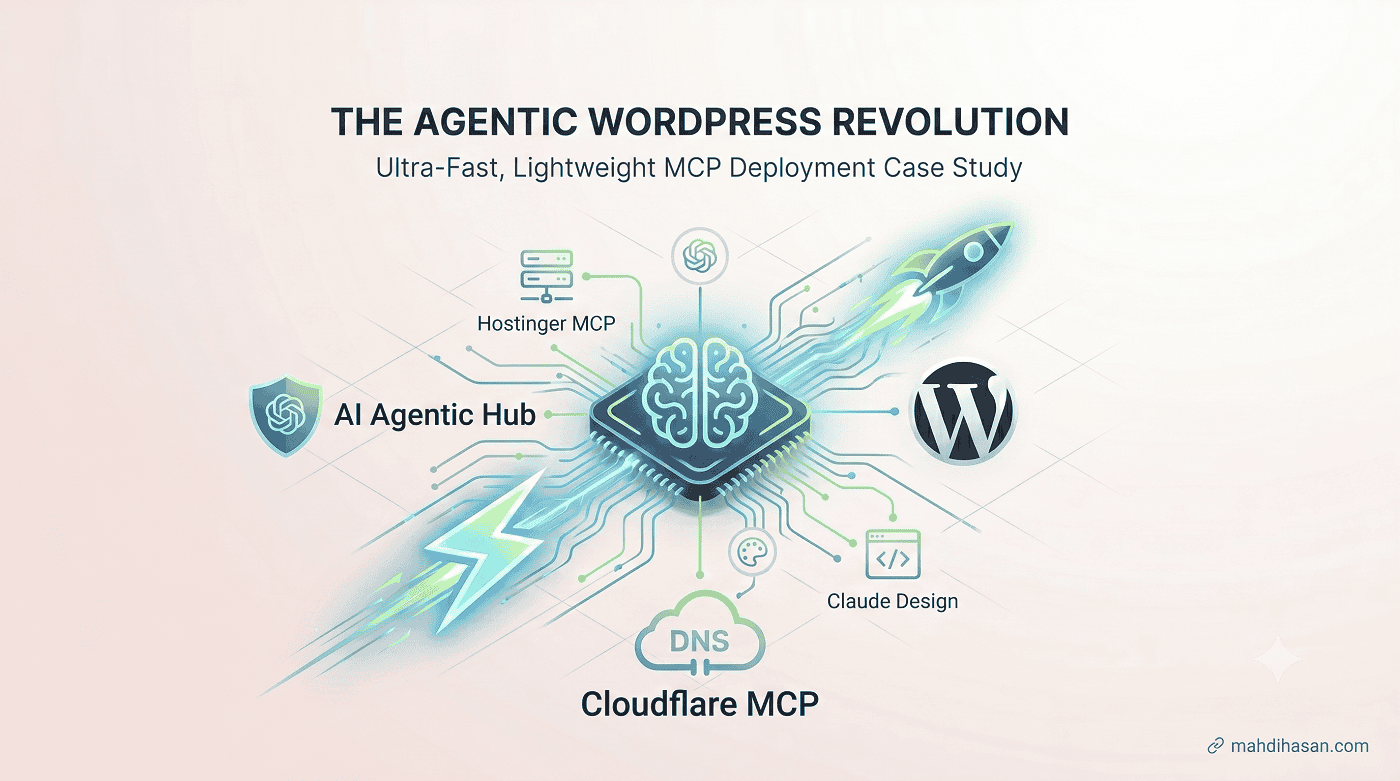
Here is the exact architecture:
- Frontend Generation: Claude Design
- Local Dev & Iteration: Local WP + Antigravity
- Live Deployment: Hostinger MCP
- DNS Management: Cloudflare MCP
- Ongoing Maintenance: MCP WordPress Remote & WP MCP Adapter
Phase 1: Zero-to-One Theme Generation with Claude Design
The first bottleneck in building lightweight SEO sites is theme development. Off-the-shelf themes carry massive technical debt. Building from scratch takes time.
Instead of relying on heavy page builders, I used Claude Design to architect the theme. By providing precise prompts detailing the required semantic HTML structure, minimal CSS, and accessibility standards, Claude generated a lean, purpose-built frontend. Because the AI is directed to optimize for speed and crawlability from the first line of code, the resulting theme is stripped of the bloated JavaScript libraries that traditionally weigh down WordPress sites.
Phase 2: Agentic Iteration with Local WP and Antigravity
Once the raw theme files were generated, the project moved to a local environment. This is where agentic AI takes over.
Using Local WP as the sandbox, I deployed Antigravity to act as my autonomous developer. Rather than manually tweaking every customizations to the theme files, I told Antigravity what to do.
The workflow here is entirely conversational and iterative:
- Antigravity reads the local file structure.
- It identifies what to change where to make the changes I need.
- It tests the local output, debugging PHP errors on the fly and fine-tuning the CSS for maximum performance.
This phase turns a static, lightweight design into a fully functional, dynamic WordPress theme in a fraction of the traditional dev time.
Phase 3: Autonomous Deployment via MCPs
Deployment is typically where technical friction peaks. Moving a local site to a live server, configuring the database, and pointing domains requires context-switching.
By leveraging the Model Context Protocol (MCP), I enabled AI agents to interface directly with my infrastructure.
- Hostinger MCP: The agent connected directly to my Hostinger environment. It spun up the live WP environment, migrated the local database, and pushed the optimized theme files directly to the live directory.
- Cloudflare MCP: Simultaneously, the agent reached into Cloudflare. It automatically managed the DNS zones, pointing the A records, configuring the SSL parameters, and setting up edge-caching rules tailored to the new site’s architecture.
What used to be a multi-tab, multi-login chore was executed via a sequence of agentic commands.
Phase 4: Inside-Out Management with WP MCP Adapter
A deployed site still needs ongoing maintenance. Traditional AI integration in WordPress usually means generating content via a third-party API and pushing it to a draft.
This stack goes much deeper. By installing the MCP WordPress Remote and the WP MCP Adapter, the WordPress installation essentially becomes an API endpoint that AI agents can directly converse with and manipulate.
This setup allows for:
- Autonomous plugin updates and conflict resolution.
- Direct manipulation of categories, posts, pages, and internal linking structures.
- Agent-driven adjustments to on-page SEO metadata based on live search console data. (Cause, guess what – GSC MCP!)
The Verdict: AI and WordPress
So, what is the fastest way to deploy a site using AI? It is no longer just using ChatGPT to write blog posts on a bloated theme. The true cutting edge of web technology lies in Agentic Orchestration.
By combining headless-like lightweight design (Claude Design) with the robust CMS of WordPress, and letting MCPs handle the DevOps (Hostinger, Cloudflare), we get the best of both worlds. We achieve the ultra-fast, lightweight performance of an Astro or Next.js build, but with the familiar, infinitely scalable backend of WordPress.
This is the future of SEO site deployment: less manual coding, zero infrastructure friction, and maximum performance.

Mahdi Hasan
Mahdi has over 11 years of experience in SEO, content writing, and content marketing. He has worked with over 100 business across industries as a content writer and SEO specialist with a proven track record in boosting organic traffic growth. He is the first Certified Professional Resume Writer (CPRW) from Bangladesh and a HubSpot certified inbound marketing professional. Now, busy dong AI automation for marketing processes and learning ComfyUI.